
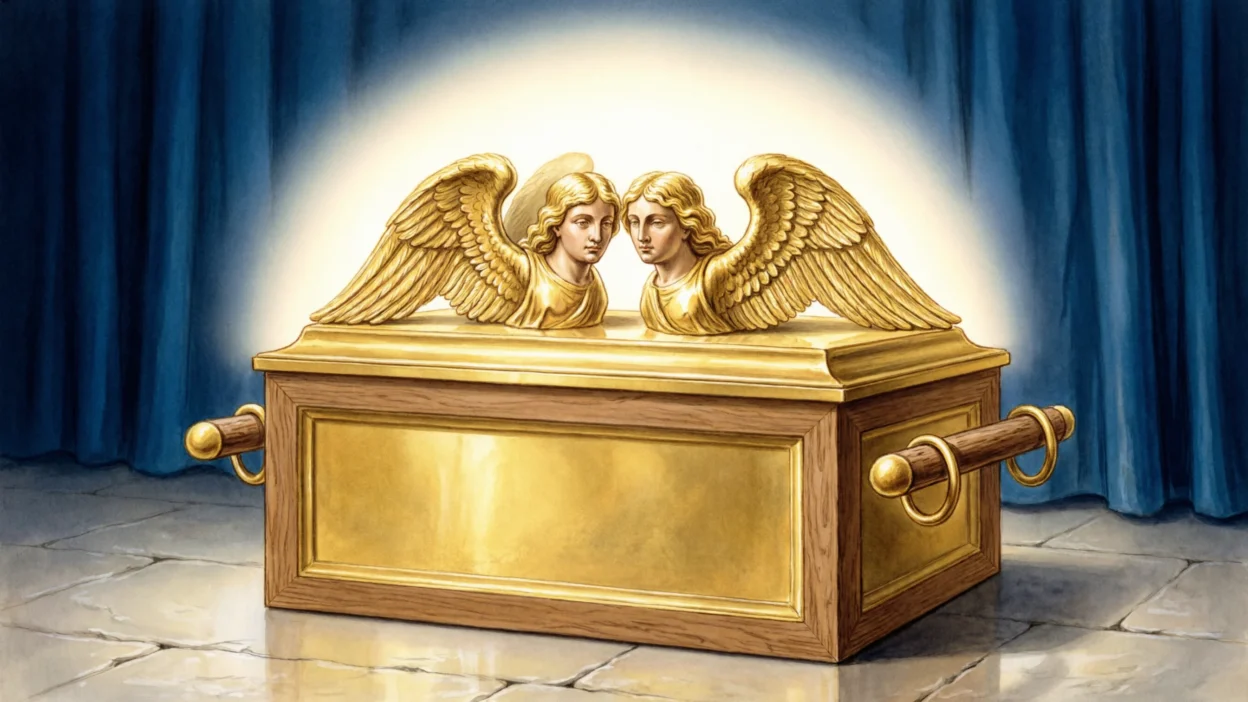
The Mercy Seat is one of the most sacred and powerful symbols in the Old Testament. Found within the Holy of Holies in the Tabernacle and later in the Temple, it represented the place where God’s presence met with His people. More than just a physical object, the Mercy Seat reveals deep truths about atonement, forgiveness, and God’s holiness.
Understanding the biblical meaning of the Mercy Seat helps connect Old Testament worship with the work of Christ in the New Testament. It shows how God made a way for sinful humanity to approach Him through mercy rather than judgment.
Biblical Meaning of the Mercy Seat
The biblical meaning of the Mercy Seat is the sacred covering of the Ark of the Covenant where atonement was made and where God’s presence symbolically dwelled among His people.
“There, above the cover between the two cherubim… I will meet with you.” (Exodus 25:22)
The Mercy Seat was the place of divine meeting, forgiveness, and covenant relationship.
The Mercy Seat in the Old Testament
The Mercy Seat was the gold lid placed on top of the Ark of the Covenant. Two cherubim faced each other above it, and it was located in the Most Holy Place.
Once a year, on the Day of Atonement, the high priest sprinkled sacrificial blood on the Mercy Seat.
“He shall sprinkle some of the blood on the front of the atonement cover.” (Leviticus 16:14)
This act symbolized the covering of the people’s sins and restored their relationship with God.
The Mercy Seat and Atonement
The Mercy Seat was directly connected to atonement.
Without the shedding of blood, there was no forgiveness of sins. The blood placed on the Mercy Seat represented a substitute sacrifice, allowing God’s mercy to triumph over judgment.
The Mercy Seat and God’s Presence
The Mercy Seat symbolized God’s throne on earth.
The space between the cherubim represented where God’s glory dwelled. It showed both His holiness and His willingness to dwell among His covenant people.
The Mercy Seat and Jesus Christ
In the New Testament, the Mercy Seat points to Jesus.
“God presented Christ as a sacrifice of atonement.” (Romans 3:25)
Jesus became the ultimate and final atonement. His sacrifice fulfilled what the Mercy Seat symbolized—complete forgiveness and direct access to God.
Through Christ, believers no longer rely on repeated sacrifices. His sacrifice was once and for all.
Spiritual Significance of the Mercy Seat
Spiritually, the Mercy Seat represents:
God’s mercy over judgment
Atonement through sacrifice
God’s holiness
Access to His presence
Fulfillment through Christ
It reveals that forgiveness comes not through human effort, but through God’s provision.
The Mercy Seat in Christian Faith Today
While the physical Mercy Seat no longer exists, its meaning continues through Christ. Believers now approach God with confidence because of Jesus’ sacrifice.
“Let us then approach God’s throne of grace with confidence.” (Hebrews 4:16)
The Mercy Seat ultimately points to God’s grace made available through Christ.
Key Characteristics of the Mercy Seat
1. It Was the Place of Atonement
Sacrificial blood was offered there.
2. It Symbolized God’s Presence
It represented His dwelling among His people.
3. It Required Sacrifice
Forgiveness involved the shedding of blood.
4. It Demonstrated Mercy
God provided a way for sins to be covered.
5. It Foreshadowed Christ
Jesus fulfilled its meaning completely.
Practical Lessons & Faith Insights
The Mercy Seat teaches that God is both holy and merciful. It reminds believers that forgiveness is costly, yet freely given through Christ. It encourages humility, gratitude, and trust in God’s redemptive plan.
Conclusion
The biblical meaning of the Mercy Seat reveals a profound truth about God’s character He is just, yet full of mercy. In the Old Testament, it was the place where atonement was made. In the New Testament, it finds fulfillment in Jesus Christ, whose sacrifice provides eternal forgiveness and direct access to God.

Benjamin Hayes brings a thoughtful and analytical voice to Dreamfys. With a strong background in research and media, he enjoys turning detailed information into easy-to-read articles. Benjamin covers topics related to knowledge, trends, and practical advice, helping readers stay informed and confident in a fast-changing world.